About Guanyin
Who Is Guanyin Bodhisattva?
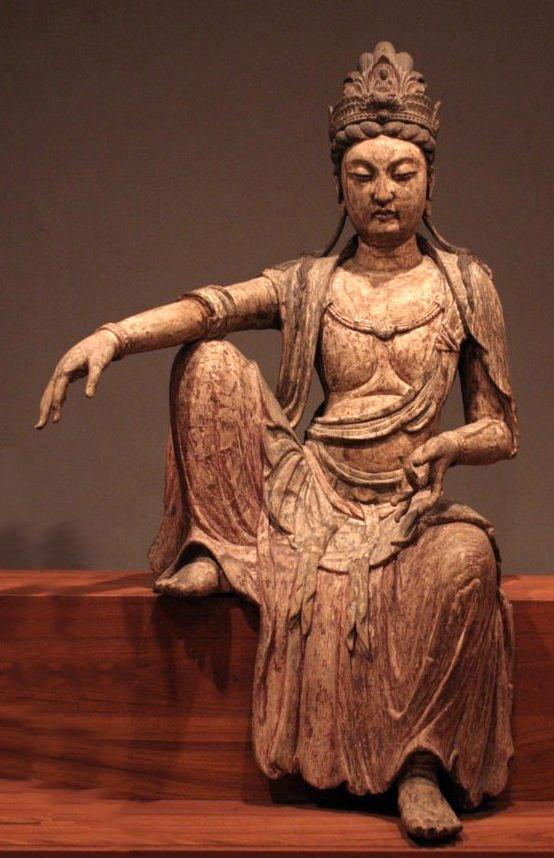
Guanyin Bodhisattva (觀世音菩薩) is the embodiment of compassion in Mahayana Buddhism — the bodhisattva who hears the cries of all beings and responds.
Origins and the Meaning of the Name
Guanyin’s name in Chinese — 觀世音 (Guānshìyīn) — means “Perceiver of the World’s Sounds.” The name captures the essence of the bodhisattva’s vow: to hear every cry, however faint, and to respond. In Sanskrit, the name is Avalokitasvara in its earliest form, meaning roughly the same thing — one who perceives the sounds of the world. A later variant, Avalokiteshvara (“Lord Who Gazes Down”), entered Chinese as Guānzìzài, the name used in Xuanzang’s translation of the Heart Sutra.
Guanyin first appears in Indian Buddhist texts around the first century CE. The Lotus Sutra’s Universal Gate chapter established the tradition of calling on Guanyin’s name in moments of danger. The Karandavyuha Sutra introduced the mantra Om Mani Padme Hum and placed Guanyin at a cosmic scale. As the tradition traveled east through Central Asia into China, the figure underwent a remarkable transformation — arriving as a male Indian prince, becoming increasingly gender-fluid through the Tang Dynasty, and settling into the predominantly female form that dominates East Asian Buddhism today.
From Male Prince to Female Form — A Gender History
Guanyin is now overwhelmingly depicted as female across East Asia, but this was not always so. Early Indian depictions — following the Sanskrit Avalokiteshvara — are consistently male: a graceful prince with a small Amitabha figure in the crown, holding a lotus or a water vase. This male form arrived in China with the first translations in the late Han dynasty (1st–2nd century CE) and persisted through the Tang. By the Song dynasty (960–1279) depictions had grown increasingly gender-ambiguous. By the Yuan and Ming periods the female form dominated. Tibetan Buddhism retains the male form to this day.
Scholars cite several causes for the shift. The Universal Gate chapter itself lists female manifestations among the 33 forms, providing canonical justification. Emerging Chinese goddess cults sought a compassionate celestial counterpart. The Princess Miaoshan legend — a devout young woman who becomes the Thousand-Armed Guanyin — became culturally central. And compassion itself is traditionally coded feminine in East Asia. The result is a tradition in which Guanyin remains unequivocally the same bodhisattva, simply presented in whatever form compassion most needs.
The Thirty-Three Manifestations
The Universal Gate chapter of the Lotus Sutra lists 33 forms in which Guanyin appears to meet beings according to their need. The list is not a devotional catalogue but a doctrinal demonstration: compassion has no fixed appearance. Among the 33 are the highest spiritual forms (buddha, pratyekabuddha, shravaka, Brahma, Indra); celestial protectors (Maheshvara, Vaishravana, heavenly generals); human forms at every station (king, elder, householder, official, brahmin, monk, nun, lay devotee); specifically female forms (wife of an elder, of a householder, of an official, of a brahmin); children (boy, girl); and even non-human forms (dragon, yaksha, gandharva, asura, garuda, kinnara, mahoraga).
The principle is named directly in the text: 應以何身得度者,即現何身而為說法 — “taking whatever form is needed to reach those who can be reached.” No being is beyond Guanyin’s vow because no form is foreign to it. When East Asian iconography later multiplies Guanyin into specialized forms — Thousand-Armed, Water-Moon, White-Robed, Eleven-Headed — each is an artistic meditation on a different aspect of this shape-shifting compassion.
Iconography and Forms
Guanyin is recognized in many forms. The standard depiction shows a graceful figure in flowing white robes, holding a willow branch or a vase of pure water — the White-Robed Guanyin (白衣觀音), the form most common in Chinese homes and temples. The Thousand-Armed, Thousand-Eyed Guanyin (千手千眼觀音) expresses limitless compassion in action — each hand holds an implement of help, each eye watches for suffering. The Water-Moon Guanyin (水月觀音) contemplates a moon reflected in still water, evoking the Buddhist teaching that compassion, like moonlight, illuminates without grasping.
In Tibetan Buddhism, Guanyin appears as Chenrezig — white-bodied, four-armed, holding a crystal mala and lotus, the embodiment of the compassion all Buddhas share. The Dalai Lama is regarded as a living emanation of Chenrezig. Across all these forms, the core identity remains constant: a presence that turns toward suffering rather than away from it.
Regional Traditions — Guanyin Across Asia
Guanyin is the same bodhisattva across every Mahayana and Vajrayana tradition, but each culture has shaped the devotion to fit its own soil. Five regional traditions are especially significant.
China (Guanyin, 觀音): Arrived male in the Han dynasty; shifted to predominantly female by the Ming. Mount Putuo in Zhejiang is the pilgrimage center, identified with the Sanskrit Potalaka. The Princess Miaoshan legend and the White-Robed form define the folk imagination. Japan (Kannon, 観音): Same scripture basis, predominantly female, concentrated in major temple complexes such as Sensō-ji in Tokyo and Hasedera in Nara. The Saigoku pilgrimage circuits 33 Kannon sites across western Japan. Korea (Gwaneum, 관음): Devotion centers on Naksansa temple on the east coast and Bomunsa on Seongmodo island. The forms are largely Chinese-influenced.
Vietnam (Quan Âm): Almost always female; ritual practice closely follows Chinese Chan patterns, with the Thousand-Armed form central to many temple complexes. Tibet (Chenrezig, སྤྱན་རས་གཟིགས་): Retains the Indian male form. Four-armed Chenrezig is the principal form; the Thousand-Armed Eleven-Headed form is also central. The Dalai Lama is regarded as a living emanation. Oṃ Maṇi Padme Hūṃ is the associated mantra. Across every tradition the core identity is the same — the one who turns toward suffering.
Guanyin in the Pure Land
Guanyin’s cosmic role is most clearly articulated in the Pure Land tradition, where the bodhisattva stands alongside Amitabha Buddha and Mahasthamaprapta as the Western Triad (西方三聖). Amitabha sits in the center — the Buddha of Infinite Light who presides over Sukhavati, the Pure Land of the West. Guanyin stands to his left, compassion personified, the one who receives beings at the moment of death and guides them to rebirth in the Pure Land. Mahasthamaprapta stands to the right — wisdom as power, completing the triad.
In Japanese Buddhist art this moment is depicted as the raigō (来迎) scene: Amitabha descends from the Pure Land with a retinue of bodhisattvas to welcome a dying devotee. Guanyin is always present, often holding a lotus dais to receive the soul. The small figure of Amitabha in Guanyin’s crown — a feature carried over from the earliest Indian iconography — is the doctrinal signature of this relationship. Some traditions teach that when Amitabha eventually enters final nirvana, Guanyin will succeed him as the Buddha Universal Light King and the Pure Land will continue.
Role in Practice
Guanyin is invoked in recitation, in the chanting of the Great Compassion Mantra (大悲咋), in the drawing of lots at Guanyin temples, and in simple, unmediated prayer. The Universal Gate chapter promises that calling Guanyin’s name — even once, in genuine distress — is enough to invoke a response. This is not magic; it is the teaching that compassion is already present and needs only to be met.
The Great Compassion Dharani (大悲咋), one of the most widely chanted texts in East Asian Buddhism, is associated with the Thousand-Armed form. It is recited for protection, healing, purification, and merit. Pilgrimage to Mount Putuo (普陀山) in Zhejiang Province — Guanyin’s legendary island abode — draws millions each year, particularly on the lunar dates marking Guanyin’s birth, enlightenment, and renunciation.
Why Cihang Is Centered on Guanyin
Cihang (慈航) means “Compassion Vessel” — the boat that carries beings across suffering. The name is inseparable from Guanyin’s vow. This sanctuary exists in that same spirit: a space where the call is heard, the scriptures are present, and the practice of drawing near to compassion can happen without a temple building, without a specific time of day, and without prior knowledge of ritual. Guanyin does not wait for conditions. Neither does Cihang.